Hilarius Psychiatric Clinic Siege
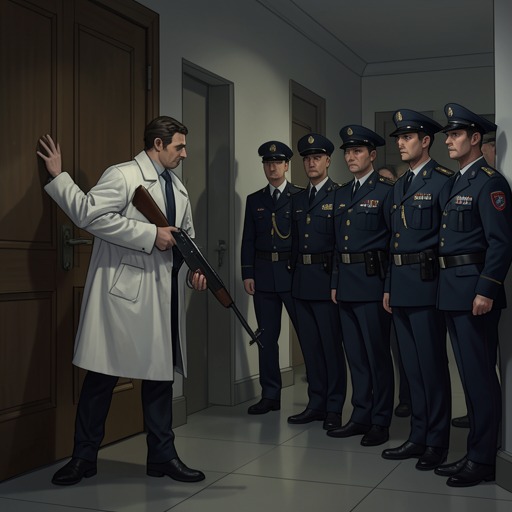
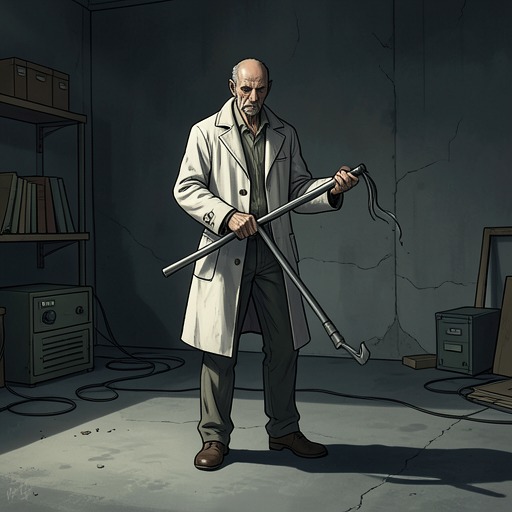
The Crying of Lot 49The Hilarius Psychiatric Clinic Siege is the armed standoff at the clinic after Dr. Hilarius, convinced that terrorists are pursuing him, barricades himself in his office with a rifle. Oedipa Maas enters the crisis as his patient and becomes a witness, hostage, and eventual intermediary. The episode turns a therapeutic relationship into a test of whether fear can be answered with violence or with an attempt to keep another person alive; it also leaves Oedipa’s own uncertainty about the Tristero unresolved.
Causes and Background
The siege begins with Dr. Hilarius’s conviction that armed men are coming for him. Nurse Blamm tells Oedipa that he believes someone is after him, has locked himself in the office with a Gewehr 43 he kept as a wartime souvenir, and has already fired at several people. Blamm describes the pursuers as three men with submachine guns whom Hilarius calls terrorists or fanatics; she also reports that he began breaking up the clinic’s PBX. His fear has therefore become a danger to people around him, not simply a private belief.
Blamm’s account places the episode within the clinic’s strained environment. She says that Hilarius could not cope and blames the pressure of the clinic, while warning Oedipa that approaching him might provoke another shot. Yet Blamm does not leave him alone: although she has been shot at, she tells Oedipa that he might need somebody. Her concern gives Oedipa a reason to approach the office despite the available route of escape through Blamm’s window.
The Standoff
When Oedipa reaches the closed office door, Hilarius asks who is there and curses May Speer and his ministry. He tells her that half his ammunition is useless. As police sirens draw nearer, he insists that the supposed pursuers can walk through walls and replicate themselves, reappearing after a person flees. He also distrusts the police, arguing that they may be part of the threat or may take him somewhere unsafe. His imagined danger has made surrender seem to him no more reliable than resistance.
The police break into the clinic, but Hilarius pulls Oedipa by the wrist into the office and locks the door again, making her a hostage in the confrontation. Oedipa calls through the door that he has a gun and that she is inside. The responding officer then asks her for personal details for the news media and wants her to keep Hilarius occupied while television crews try to film through a window. The public emergency thus turns her private visit into a scene watched and recorded from outside.
Buchenwald and the Past
Inside the office, Hilarius explains that the place where he made the face he describes, and where he interned, was Buchenwald. He recalls a young man named Zvi who saw that face and, in Hilarius’s account, was left hopelessly insane. Hilarius claims that the face can drive anyone who sees it into lasting madness, and links his present terror to a wartime past he had not previously disclosed to Oedipa. The siege exposes the history behind the doctor’s fear without establishing that the armed pursuers he imagines are real.
Hilarius also describes an earlier hope that confronting the unconscious through therapy could make its frightening contents harmless. He says that he tried to believe the darkness could be transformed into ordinary, benign things, but that his efforts had not been enough to keep the pursuers away. His account makes the clinic’s treatment setting part of the crisis: the promise that fear can be brought into social life has collapsed, while his belief in persecution has become absolute.
Oedipa’s Intervention and Resolution
Oedipa came hoping Hilarius could talk her out of a fantasy. During the siege, he instead urges her to cherish it, warning that losing it means ceasing to be. When he leaves the rifle within reach and moves across the room, Oedipa picks it up and points it at him. She recognizes that he wanted her to take the weapon. The gesture briefly places her in the role of his potential killer, but she does not fire. She tells him she came to seek help, then calls for the police to come in and orders them to break down the door, holding Hilarius responsible for the damage.
Once outside, Oedipa sees a KCUF mobile unit with her husband, Mucho Maas, inside, broadcasting from the clinic grounds. Hilarius is taken to a community hospital for observation. Police ask Oedipa to remain near the clinic in case legal action follows, and she later follows Mucho back to the station, where he has the overnight broadcasting shift. The immediate standoff has ended, but the episode leaves Hilarius in medical custody and Oedipa entangled in the public aftermath of his breakdown.
Significance and Uncertainty
The siege is also set against Oedipa’s search for the Tristero. Earlier, a message on a restroom wall directs readers to contact Kirby through WASTE; at Yoyodyne, Oedipa recognizes the same symbol on Stanley Koteks’s envelope, and Genghis Cohen later finds it as a watermark on a stamp. In San Francisco, she follows a W.A.S.T.E. carrier after depositing a sailor’s letter, tracing a route through Oakland and Berkeley that returns her to John Nefastis’s apartment. These separate clues give her reason to imagine a hidden network, but they do not prove that the people connected to them are acting together.
Afterward, Oedipa discovers that Pierce Inverarity owned properties associated with several of her lines of inquiry, including the shopping center containing Zapf’s Used Books and the Tank Theatre. She wonders whether the people and clues connected to the Tristero are all Inverarity’s agents, whether the apparent network is genuine, or whether she is hallucinating or being subjected to an elaborate plot. The siege does not solve that mystery. Instead, the crisis at the clinic sharpens the distinction Oedipa is trying to make: a persecutory belief can become dangerous, but the existence of one breakdown does not establish that every hidden connection she has encountered is imaginary.